
Navigating B2B lead identification tools gets tricky, especially as 2025 brings tighter budgets and more scrutiny on every euro spent. Many businesses turn to platforms like Leadfeeder to transform anonymous website visits into real, qualified leads. Yet, understanding leadfeeder pricing, plan options, and what you really get can be confusing and directly affect your ROI. This guide will break down Leadfeeder’s pricing for 2025, compare features across plans, analyze value, share cost-saving strategies, and help you pick the right plan for your unique needs.
Leadfeeder Pricing Overview 2025
Understanding leadfeeder pricing is essential for any B2B team aiming to maximize ROI and control costs as budgets tighten in 2025. With the increasing demand for actionable website visitor data, Leadfeeder has positioned itself as a go-to solution for companies seeking to identify and qualify anonymous web traffic efficiently.
Let’s break down how the platform structures its plans, what you can expect to pay, and how you can make the most strategic choice for your business.
Leadfeeder’s Position and Plan Structure
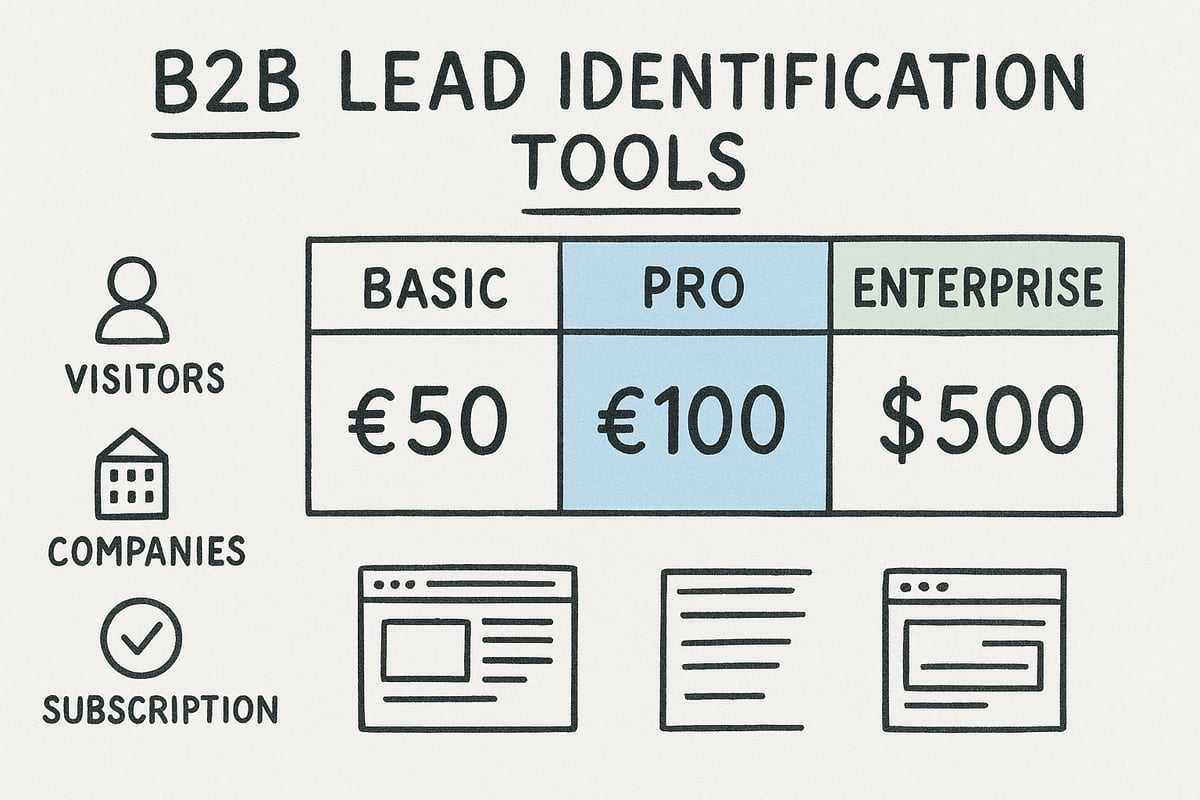
Leadfeeder stands out as a leading B2B website visitor identification platform, empowering businesses to turn anonymous website visits into tangible sales opportunities. The platform offers two main plans: a Free plan and a Premium (Paid) plan. Each is designed to serve different business needs, from startups to large-scale enterprises.
Leadfeeder pricing is transparent and usage-based, meaning you only pay for the number of unique companies identified each month, not for the total number of visits or sessions. This approach ensures that businesses of all sizes can align their investment with the actual value they receive.
All pricing is listed in euros, reflecting Leadfeeder’s European base. For non-European customers, USD equivalents are provided at checkout, making budgeting straightforward no matter where your business operates.
2025 Pricing Tiers and Real-World Examples
In 2025, leadfeeder pricing starts at €139 per month (on annual billing) for up to 100 identified companies. As your traffic grows, the price scales accordingly. For example, a business identifying 1,000 unique companies per month would pay €475 monthly on an annual subscription. At the highest tier, companies identifying between 20,001 and 40,000 unique visitors can expect to pay up to €2,999 per month.
Here’s a quick snapshot of current pricing tiers:
| Tier (Unique Companies/Month) | Annual Price (EUR/mo) | Monthly Price (EUR/mo) |
|---|---|---|
| Up to 100 | €139 | €189 |
| Up to 500 | €273 | €369 |
| Up to 1,000 | €475 | €639 |
| Up to 5,000 | €1,099 | €1,499 |
| 20,001–40,000 | €2,999 | €3,999 |
All paid plans offer a 14-day free trial, so you can test premium features before making a commitment. No credit card is required for the trial, making it risk-free to evaluate the platform’s impact on your lead generation strategy.
Billing Options, Savings, and Value
One of the most attractive aspects of leadfeeder pricing is the ability to save significantly with annual billing. Annual plans typically deliver 30–40% savings compared to monthly billing, allowing you to stretch your marketing budget further. For businesses with predictable website traffic, this can mean thousands of euros saved each year.
Monthly billing remains available for those who prefer flexibility, but keep in mind the higher cost per month. The platform’s clear pricing tiers and no hidden fees make it easy to forecast expenses and avoid surprises.
For a detailed breakdown of each pricing tier and feature set, you can consult this Leadfeeder Pricing & Plans in 2025 resource, which dives deep into the cost structures and benefits for different business sizes.
Comparison Table: How Does Leadfeeder Stack Up?
To help you benchmark leadfeeder pricing, here’s a quick comparison to a popular competitor:
| Platform | Entry Price (EUR/mo) | Scaling Model | Free Plan | Key Differences |
|---|---|---|---|---|
| Leadfeeder | €139 (annual) | Per identified company | Yes | Transparent pricing, EU focus |
| Albacross | €79 (annual) | Per identified company | Yes | Less transparent, global claims |
While Albacross offers a lower starting price, Leadfeeder’s transparent structure and strong European database make it a preferred choice for many B2B teams seeking reliability and clarity.
Subscription Model: Pricing Per Website
It’s important to note that leadfeeder pricing is calculated per website. If your organization manages multiple domains, each will require its own subscription. This model allows for tailored tracking and ensures accurate reporting for each individual site.
Choosing the right plan depends on your unique company identification needs and your business’s growth trajectory. By understanding the pricing structure, you can confidently select a plan that delivers the best value without overpaying.
Leadfeeder Free Plan: Features & Limitations
Navigating leadfeeder pricing can be tricky, especially when budgets are tight and every euro counts. The free plan is a tempting entry point, but is it enough for your business goals? Let’s break down exactly what you get—and where you might hit a wall.
What’s Included in the Free Plan?
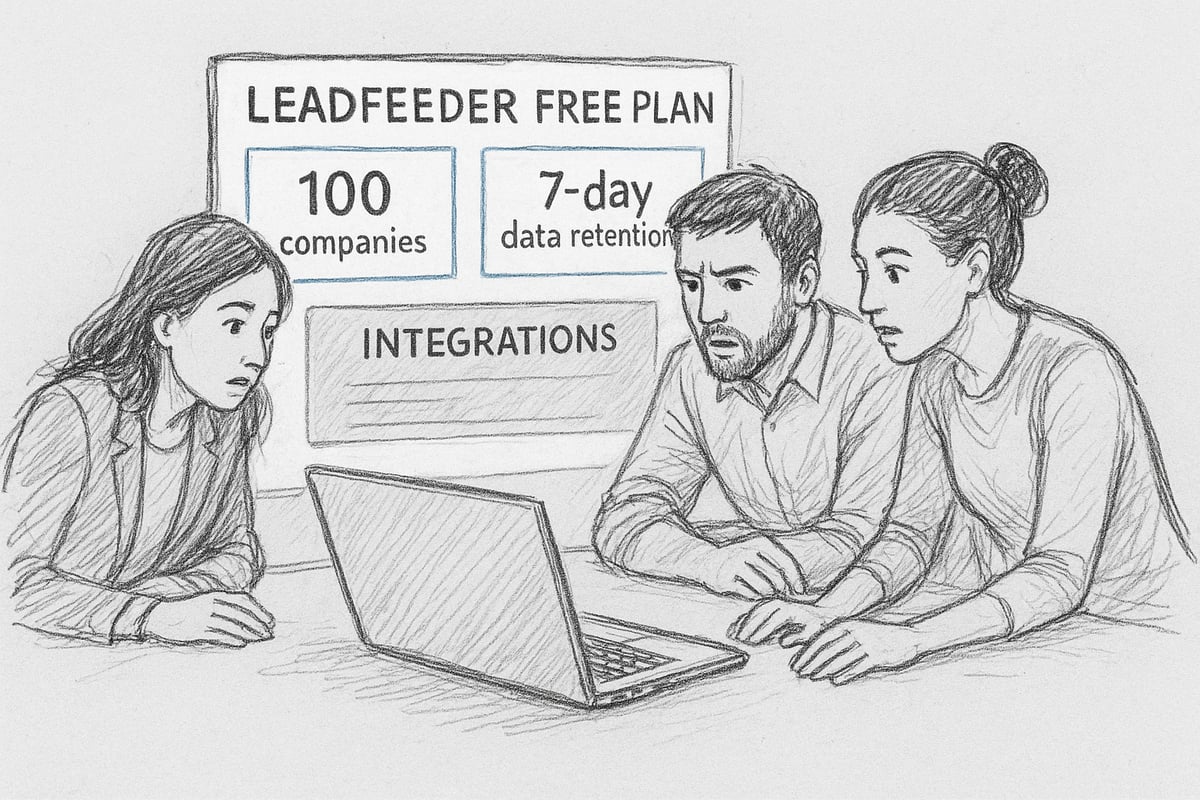
The Leadfeeder free plan is designed to give you a taste of powerful B2B lead identification without any upfront commitment. With this plan, your team enjoys unlimited user access, making it ideal for startups and micro businesses wanting to experiment with leadfeeder pricing before investing.
You can identify up to 100 unique companies each month. This cap allows you to monitor a steady flow of potential leads, as long as your website traffic is modest. Data on these visitors is stored for 7 days, providing a short window to act on fresh leads. You’ll also have access to the platform’s core functionalities, so you can explore how leadfeeder pricing translates into real-world value.
No credit card is needed to sign up, so there’s zero risk for your team. For example, a small startup could use the free plan to validate if website visitor identification fits into its broader sales process. This hands-on approach helps businesses see if upgrading is justified.
If you’re comparing leadfeeder pricing to other free solutions, you’ll find more tips and tools in this guide on free lead generation strategies, helping you build a cost-effective pipeline from day one.
Limitations and When to Upgrade
While the free plan offers a strong introduction, it comes with clear boundaries that can limit your growth. Leadfeeder pricing for the free tier does not include access to deeper company or contact details, so you won’t get crucial emails or phone numbers needed for direct outreach.
You also miss out on tracking visitor interactions, such as which pages were viewed or which forms were filled out. Integrations with CRM systems, marketing tools, and advanced filters are locked behind paid plans. This makes the free plan unsuitable for sales or marketing teams that need a robust qualification process.
Leadfeeder pricing for the free plan is best suited to micro-businesses or those in an initial evaluation phase. Most B2B teams will quickly realize the limitations—especially as competitors have described the free tier as “barebones” compared to paid alternatives. If your company relies on high-volume lead generation or needs automation and integration, upgrading is essential.
For instance, once a team grows beyond basic prospecting, the lack of data retention and actionable insights can stall momentum. Evaluating leadfeeder pricing at this stage means considering the ROI of advanced features versus the risk of missed opportunities.
Leadfeeder Premium Plan: Tiers, Features & Value
Choosing the right leadfeeder pricing tier can make a significant impact on your B2B lead generation ROI. The Premium Plan is where Leadfeeder’s advanced capabilities truly shine, offering robust data, automation, and integrations designed for scaling teams.
Premium Plan Pricing Tiers Explained
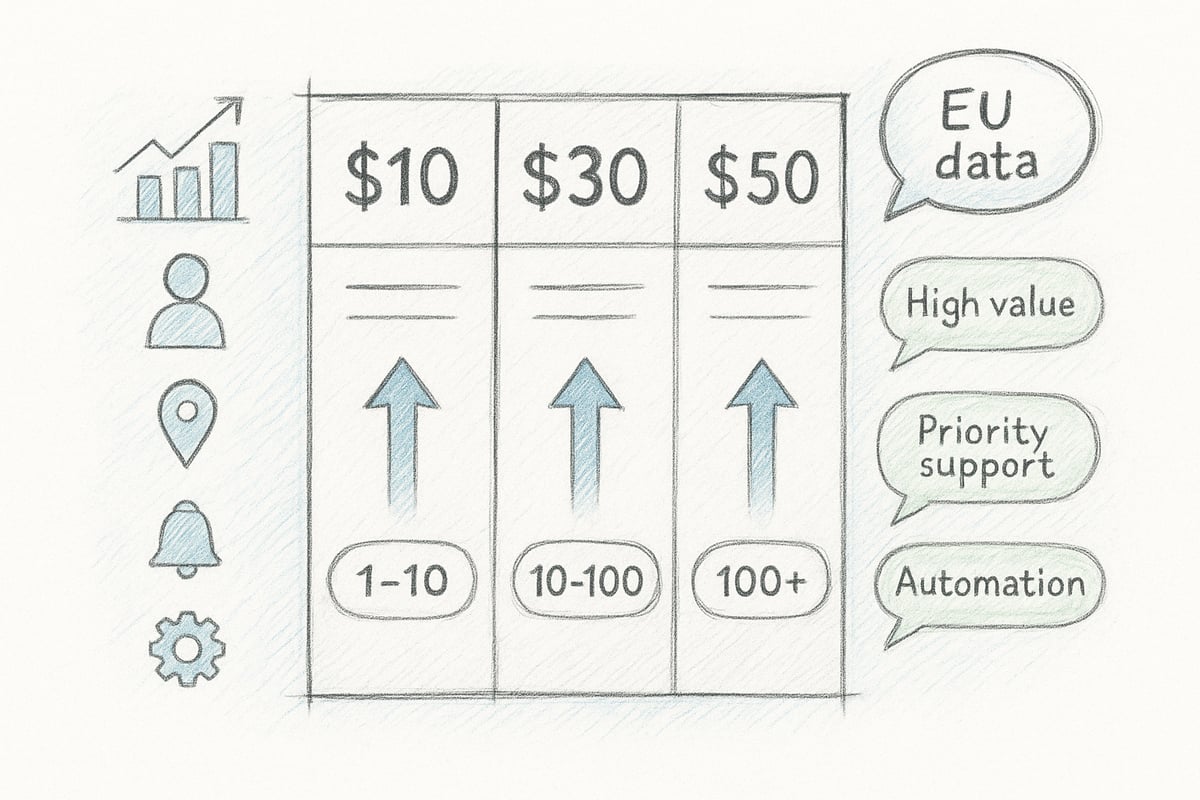
Understanding leadfeeder pricing starts with its transparent, usage-based model. The Premium Plan lets you pay only for the unique companies identified each month, not for total website sessions. This means you invest directly in actionable leads, aligning spend with real business opportunity.
Here is a summary of 2025 pricing tiers:
| Unique Companies/Month | Annual Price (EUR) | Monthly Price (EUR) | Savings (Annual vs. Monthly) |
|---|---|---|---|
| Up to 100 | €139/mo | €199/mo | ~30% |
| Up to 500 | €277/mo | €397/mo | ~30% |
| Up to 1,000 | €475/mo | €679/mo | ~30% |
| 5,001–10,000 | €1,499/mo | €2,149/mo | ~30% |
| 20,001–40,000 | €2,999/mo | €4,299/mo | ~30% |
With annual billing, you can save up to 40 percent compared to monthly. For example, a SaaS company identifying 1,000 unique companies per month would pay €475/mo on an annual plan.
Leadfeeder pricing is per website, so tracking multiple domains requires separate subscriptions. This is crucial for agencies or companies managing more than one brand.
Compared to Albacross, which starts at €79/mo, Leadfeeder provides transparent scaling and a clear pay-per-identified-company model. Albacross’ pricing becomes less clear as volume grows, while Leadfeeder makes it easy to forecast costs.
The Premium Plan also includes a 14-day free trial, allowing you to test all features before committing.
Key Features of the Premium Plan
The Premium Plan unlocks the full potential of leadfeeder pricing by delivering a robust suite of features designed for growth-focused B2B teams.
- Unlimited data retention: Analyze historical visitor data to spot long-term sales trends and seasonality.
- Verified firmographics and contact details: Access company information, emails, and phone numbers for rapid outreach.
- Visitor activity insights: See what pages leads view, which assets they download, and when they fill out forms.
- Custom feeds and filters: Build targeted lists based on company size, industry, or engagement, streamlining lead qualification.
- Automated notifications: Receive instant alerts via email or Slack when high-value companies visit your site.
- Powerful integrations: Connect seamlessly with CRM tools like HubSpot and Salesforce, marketing automation, Slack, Zapier, and more.
- Advanced segmentation: Track account-based activity, prioritize by buying signals, and score leads for sales readiness.
For example, a marketing team can use custom filters to zero in on leads from specific industries with high engagement, then push those straight into their CRM for immediate follow-up.
Leadfeeder pricing gives you access to these features at every tier, ensuring that even smaller teams can benefit from enterprise-grade capabilities. The flexibility to scale as your business grows makes it a strong contender in the B2B lead identification space.
Value Analysis: Is Premium Worth the Cost?
When evaluating leadfeeder pricing, consider the ROI not just in terms of raw leads, but in sales efficiency and revenue impact. The Premium Plan puts rich firmographic and behavioral data at your fingertips, enabling sales teams to focus on high-fit, in-market accounts.
Automation and integrations mean less time spent manually qualifying leads and more time closing deals. With coverage of 66M+ companies, Leadfeeder is especially valuable for businesses targeting the European market, where data depth can be a differentiator.
For instance, a B2B company integrating Leadfeeder with their CRM and Slack can automate lead routing, instantly alerting reps to hot prospects. This often leads to a measurable increase in qualified pipeline.
While some competitors offer lower entry prices, they may lack the advanced features, data coverage, or integration depth found in Leadfeeder. To benchmark value and see how Leadfeeder stacks up against alternatives, you can explore this Leadfeeder Pricing, Features & Alternatives [2025] review for more insights.
Ultimately, leadfeeder pricing is best justified when the value of a single converted deal far exceeds the monthly spend. For most B2B teams, the Premium Plan’s automation, integrations, and data depth unlock efficiencies that pay for themselves many times over.
Comparing Leadfeeder to Alternatives
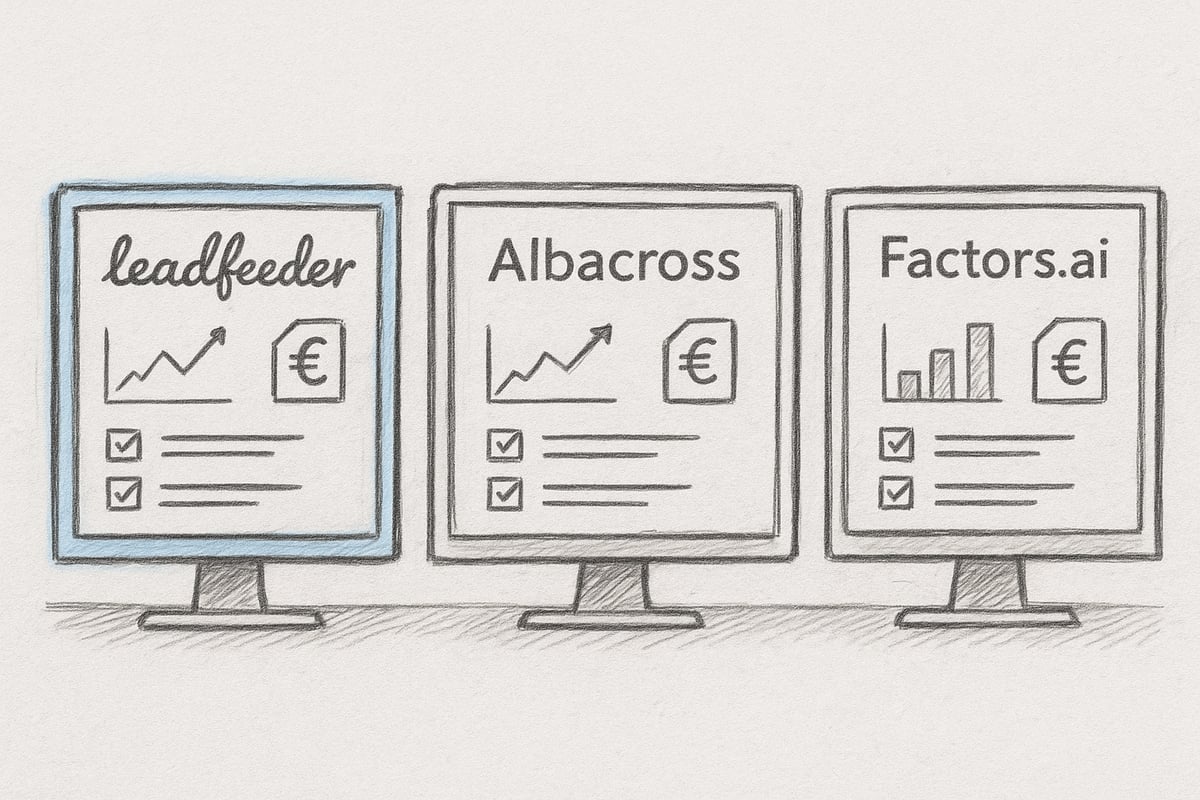
Choosing the right B2B lead identification tool is no small feat. With so many platforms offering similar promises, understanding how leadfeeder pricing stacks up against its main competitors is essential for making a smart investment. Let’s break down how Leadfeeder compares with Albacross, Factors.ai, Warmly, and others in terms of features, pricing transparency, and overall value.
Leadfeeder vs. Albacross: Pricing & Features
When comparing leadfeeder pricing to Albacross, the first thing you’ll notice is the difference in transparency. Leadfeeder publishes clear pricing tiers, starting at €139 per month (annual) for up to 100 unique companies, scaling up as your traffic grows. Albacross, in contrast, advertises a starting price of €79 per month but keeps its higher-tier pricing less visible, requiring you to request a quote as your volume increases.
Both platforms use a pay-per-identified-company model, so you only pay for unique businesses detected, not total website sessions. This can be a game-changer for companies with high traffic but a focused B2B audience.
Here’s a quick feature comparison:
| Feature | Leadfeeder | Albacross |
|---|---|---|
| Transparent pricing tiers | Yes | Limited |
| Free plan | Yes (up to 100 companies) | Limited trial |
| Data retention | 7 days (Free), Unlimited (Premium) | Unlimited |
| CRM integrations | Extensive (HubSpot, Salesforce, etc.) | Yes |
| European company database | 66M+ | Not specified |
| Automated notifications | Yes | Yes |
Leadfeeder’s biggest advantage is its deep European data coverage and straightforward pricing. If your business is focused on the EU market, this can deliver more relevant leads and a better ROI. Albacross, however, claims to have the largest IP-to-company mapping database, though they don’t publish numbers. Both tools support CRM integrations and automated lead alerts, but Leadfeeder’s free plan gives more hands-on access for new users to test core features.
For a broader look at how these platforms compare, check out this Leadfeeder alternatives comparison, which breaks down strengths, weaknesses, and pricing models across the market.
Leadfeeder vs. Other Competitors (e.g., Factors.ai, Warmly)
Looking beyond Albacross, several other platforms have entered the B2B website visitor identification space, each with unique twists on pricing and features. When considering leadfeeder pricing relative to Factors.ai and Warmly, the differences come down to analytics, integrations, and buyer intent capabilities.
Factors.ai positions itself as more than just a lead identification tool. It combines visitor tracking with robust go-to-market analytics, attribution, and campaign measurement. This all-in-one approach may appeal to marketing teams wanting to unify reporting, but it can come at a higher starting cost or require custom quotes. Warmly, meanwhile, emphasizes both company and individual-level identification, plus live engagement tools that allow sales reps to act in real time.
Here are a few differentiators to consider:
- Database size: Leadfeeder boasts 66M+ European companies, while Factors.ai and Warmly do not publish exact numbers.
- Integrations: Leadfeeder supports a broad range of CRM and marketing automation tools, making it easy to fit into existing sales workflows.
- Pricing transparency: Leadfeeder pricing is public, while Factors.ai and Warmly may offer more flexible packages but require a demo or sales call for details.
- Buyer intent and orchestration: Competitors like Factors.ai highlight advanced intent signals and orchestration features, which may be overkill for some teams.
For example, a marketing leader choosing between leadfeeder pricing and a Warmly subscription might prioritize Leadfeeder’s CRM integrations and European data coverage if their sales team is focused on EMEA. On the other hand, a company seeking advanced attribution and intent data could find Factors.ai’s analytics worth the extra investment, provided the pricing matches their budget.
Ultimately, the best choice depends on your team’s workflow, data needs, and the value you place on transparency and integrations. Using a free trial or demo is the smartest way to benchmark each solution for your unique situation.
How to Choose the Right Leadfeeder Plan for Your Business
Choosing the right Leadfeeder plan can mean the difference between wasted spend and maximized pipeline growth. With several pricing tiers and features, it's vital to align your selection with your business’s unique needs and budget realities.
Assessing Your Needs and Website Traffic
Start by estimating your average monthly unique company visitors. Use analytics tools to get an accurate count, since leadfeeder pricing is based on this number. For instance, if your B2B SaaS site attracts 500 unique companies each month, you’ll likely fit into the €377/mo (annual) plan.
Next, consider your sales and marketing team’s size and workflow. Are you generating enough leads to justify a premium tier, or is the free plan enough for initial testing? Evaluate whether your team needs deep integrations with your CRM, Slack, or marketing automation tools, as these are only available on paid plans.
Geographic focus is also crucial. Leadfeeder’s strong European data coverage is a major asset for EU-focused businesses. If you’re targeting this region, the value per euro spent is potentially much higher compared to alternatives.
Don’t forget to use the 14-day free trial to benchmark value. Test the platform’s features, integrations, and lead identification volume before committing. For a deeper look at Leadfeeder’s strengths and how it performs for different business types, check out this detailed Leadfeeder Review: Is It Worth It in 2025 [Reviewed].
Maximizing Value & Reducing Costs
Once you know your needs, use leadfeeder pricing to your advantage. Opt for annual billing if possible, as it can save you 30 to 40 percent compared to paying monthly. This is a simple way to stretch your marketing budget further.
Leverage custom filters and lead scoring to focus your efforts on high-value accounts. By prioritizing the most engaged and relevant leads, you’ll see a better return on your investment in leadfeeder pricing. Integrate the tool with your CRM and automate notifications so your team acts fast when top accounts visit your site.
Regularly review your usage stats. If your unique company identification drops, consider downgrading to a lower pricing tier to avoid overpaying. Many teams use the free plan for onboarding or testing new markets before scaling up.
For benchmarking Leadfeeder against other solutions, this B2B lead generation companies guide can help you evaluate alternatives and find the plan that delivers the best balance of features and value.
Leadfeeder Pricing FAQs & Expert Tips
Struggling to make sense of leadfeeder pricing as you plan your 2025 budget? You’re not alone. Many B2B teams want clarity on subscriptions, features, and how to get the most bang for their buck. Here, we break down the most common questions and expert strategies so you can confidently invest in the right plan for your business.
Can I use Leadfeeder for multiple websites?
No, each website requires its own subscription. If you manage several domains, you’ll need a separate leadfeeder pricing plan for each. This approach helps businesses track unique company visits per site but may increase costs for multi-domain organizations.
What counts as a unique company in leadfeeder pricing?
A unique company is counted only once per billing period, no matter how many times it visits your website. Multiple sessions from the same company do not incur extra charges, which keeps your cost predictable as your traffic scales.
How does Leadfeeder compare on data coverage and accuracy?
Leadfeeder stands out for its European data coverage, with over 66 million companies in its database. This is especially valuable for businesses targeting the EU market. For a detailed comparison of feature sets, coverage, and leadfeeder pricing against other platforms post-merger, see this Leadfeeder vs. LeadLander: How they Stack Up After the Merger analysis.
Which integrations are available, and which are most valuable for B2B teams?
Leadfeeder integrates with major CRMs (like HubSpot and Salesforce), Slack, Zapier, Google Analytics, and marketing automation tools. The most valuable integrations depend on your workflow, but syncing with your CRM and setting up real-time Slack notifications are top choices for most B2B sales teams.
Are there any setup fees or hidden costs in leadfeeder pricing?
No, leadfeeder pricing is transparent. You pay only for the number of unique companies identified each month. There are no onboarding fees, data export charges, or surprise add-ons. Upgrading or downgrading your plan is straightforward, and monthly billing allows you to cancel anytime.
How secure is Leadfeeder’s data?
Data privacy is a priority. Leadfeeder is GDPR compliant, hosts data in secure EU data centers, and maintains strict protocols to protect your information.
Can I cancel or change my plan at any time?
Yes, you can manage your subscription without long-term contracts. Monthly plans offer maximum flexibility, while annual plans provide significant savings if you’re ready for a longer commitment.
Quick Comparison Table
| Feature | Leadfeeder | Albacross | LeadLander |
|---|---|---|---|
| Starting Price (per month) | €139 | €79 | €149 |
| Free Plan Available | Yes | Yes | No |
| Unique Company Counting | Yes | Yes | Yes |
| EU Data Coverage | Extensive | Strong | Moderate |
| CRM Integrations | HubSpot, Salesforce | HubSpot | Salesforce |
| Data Retention (Premium) | Unlimited | Unlimited | 90 days |
For a broader perspective, you can also benchmark Leadfeeder against other top lead generation companies to ensure you’re making the most informed decision.
Expert Tips to Maximize Your Investment
- Start small: Begin with a lower tier of leadfeeder pricing, then scale up as your unique company volume and ROI grow.
- Use the free trial: Test all features with the 14-day trial before committing.
- Automate and integrate: Connect with your CRM and Slack to streamline lead routing and boost sales productivity.
- Review usage monthly: Track your identified companies and optimize filters to avoid paying for leads you don’t need.
- Leverage annual billing: Save up to 40 percent by switching from monthly to annual plans.
- Stay agile: Regularly compare your plan against competitors and your evolving business needs.
Many companies report a significant jump in sales efficiency after integrating Leadfeeder with their core tools. A startup, for example, began on the free plan and upgraded as their pipeline expanded, seeing measurable gains in qualified leads.
Understanding leadfeeder pricing and using these expert strategies will help you unlock the platform’s full potential while protecting your budget. Ready to take the next step? Start with a free trial, analyze your results, and choose the plan that matches your goals.
Now that you’ve got a clear picture of Leadfeeder’s pricing, features, and how it stacks up against the competition, you might be wondering how to put these insights into action for your own business growth. If you want a personalized game plan for converting more leads and boosting your sales pipeline, why not talk it through with experts who do this every day? I invite you to Book a FREE Strategy Call with the Adstra team—you’ll get tailored advice based on your goals, traffic, and challenges. Let’s turn qualified leads into real revenue together!