
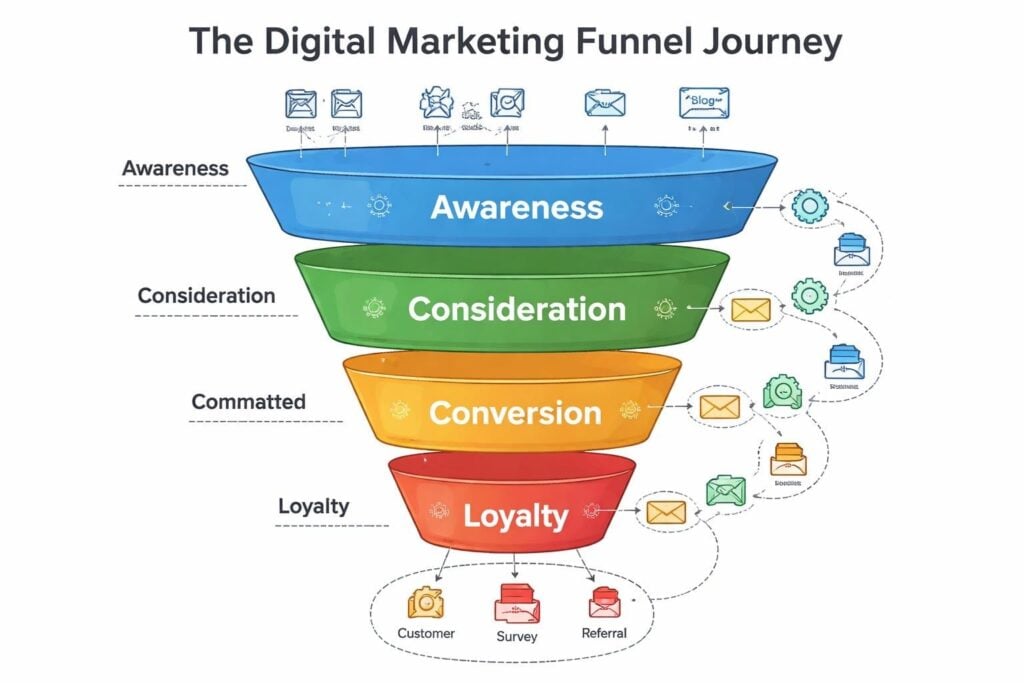
The digital landscape has evolved dramatically, but one strategic framework remains absolutely critical for business growth: the funnel in digital marketing. This proven model transforms strangers into customers through strategic touchpoints and carefully orchestrated experiences. For businesses investing in lead generation, understanding this framework isn't optional-it's the difference between scattered efforts and predictable revenue. In 2026, with AI-powered tools and sophisticated automation, the funnel in digital marketing has become more precise, measurable, and profitable than ever before.
Understanding the Core Funnel in Digital Marketing Structure
Every successful digital campaign relies on a structured approach to moving prospects through stages of awareness, consideration, and decision-making. The complete guide to digital marketing funnels demonstrates how businesses can systematically nurture leads rather than hoping for instant conversions.
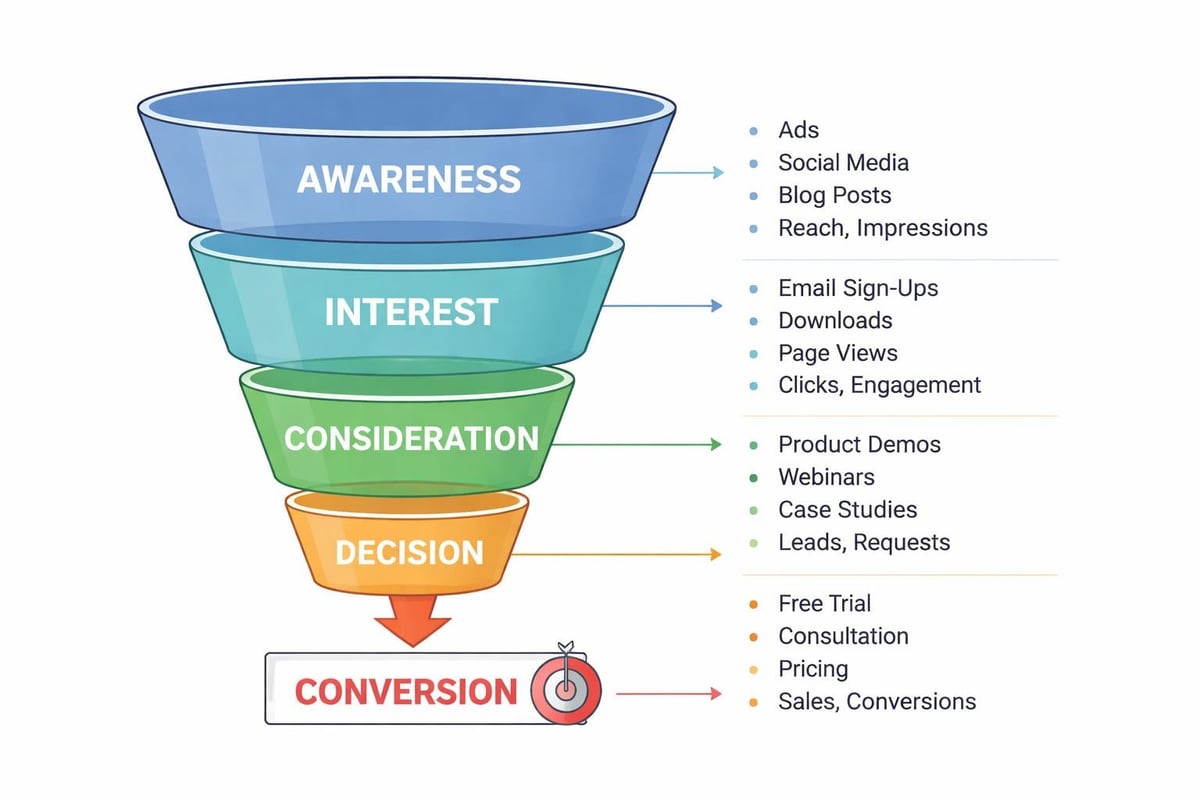
The traditional funnel in digital marketing consists of four primary stages:
- Awareness: Prospects discover your brand and realize they have a problem
- Interest: They actively research solutions and engage with your content
- Decision: Prospects evaluate options and consider specific offers
- Action: The conversion happens, transforming prospects into customers
Why Modern Funnels Demand Strategic Precision
The funnel in digital marketing has become increasingly competitive. Prospects receive hundreds of marketing messages daily, making differentiation absolutely essential. Your funnel must deliver value at every stage, not just promotional content.
Unlike traditional marketing approaches, digital funnels provide measurable data at each touchpoint. You can track exactly where prospects drop off, which messages resonate, and what content drives conversions. This transparency enables continuous optimization, turning your funnel into a revenue-generating machine.
Building Your Top-of-Funnel Awareness Strategy
The awareness stage determines whether prospects even enter your funnel in digital marketing ecosystem. This is where most businesses waste resources by targeting everyone instead of qualified prospects who actually need their solution.
Effective awareness strategies focus on three core approaches:
- Content Marketing: Educational resources that address specific pain points
- Paid Advertising: Targeted campaigns reaching ideal customer profiles
- Social Proof: Demonstrating credibility through case studies and testimonials
Content That Captures Qualified Attention
Generic content doesn't work in 2026. Your awareness content must speak directly to specific problems your ideal customers face. When you understand the marketing funnel stages from Amazon Ads, you realize awareness isn't about volume-it's about attracting the right people.
For B2B lead generation companies, this means creating content that addresses executive-level concerns. Articles about scaling revenue, reducing acquisition costs, or improving sales efficiency naturally attract decision-makers. The goal isn't maximum traffic; it's qualified traffic that converts.
Advanced AI tools in marketing now enable hyper-personalization at scale. You can segment audiences based on behavior, industry, company size, and dozens of other factors, ensuring your awareness content reaches prospects most likely to convert.
| Awareness Tactic | Best For | Typical Conversion Rate |
|---|---|---|
| SEO Content | Long-term organic growth | 2-5% to next stage |
| Paid Search | Immediate qualified traffic | 5-10% to next stage |
| LinkedIn Ads | B2B decision-makers | 3-7% to next stage |
| Webinars | High-intent prospects | 15-25% to next stage |
Nurturing Interest Through Strategic Content
Once prospects enter your funnel in digital marketing, the nurturing process determines whether they advance or disappear. This middle stage requires patience and strategic content that builds trust while demonstrating expertise.
The interest stage separates mediocre funnels from exceptional ones. Prospects are evaluating multiple options, consuming content from competitors, and forming opinions about which solution best fits their needs.
Creating a Content Marketing Funnel That Converts
Understanding how to craft an effective content marketing funnel means aligning content types with prospect readiness. Someone in the interest stage doesn't want a sales pitch-they want proof your solution actually works.
High-performing interest-stage content includes:
- Case studies showing measurable results
- Comparison guides helping prospects evaluate options
- Educational webinars demonstrating expertise
- Email sequences delivering consistent value
- Interactive tools providing personalized insights
Your nurturing sequence should address common objections before prospects even voice them. If cost is typically a concern, create content demonstrating ROI. If implementation complexity worries prospects, showcase your onboarding process and support system.
The B2B SaaS qualified demos playbook illustrates how strategic nurturing converts curiosity into commitment. By the time prospects reach your demo or consultation, they should already believe your solution works-they're just confirming fit.
Optimizing Decision-Stage Conversion Mechanisms
The decision stage is where your funnel in digital marketing either delivers revenue or loses qualified prospects to competitors. This critical juncture requires removing friction while creating urgency around taking action now versus later.
Most businesses lose deals not because prospects don't want their solution, but because the path to purchase contains unnecessary obstacles. Complex forms, unclear pricing, or delayed response times give prospects reasons to delay decisions or choose competitors.
Reducing Friction in Your Conversion Process
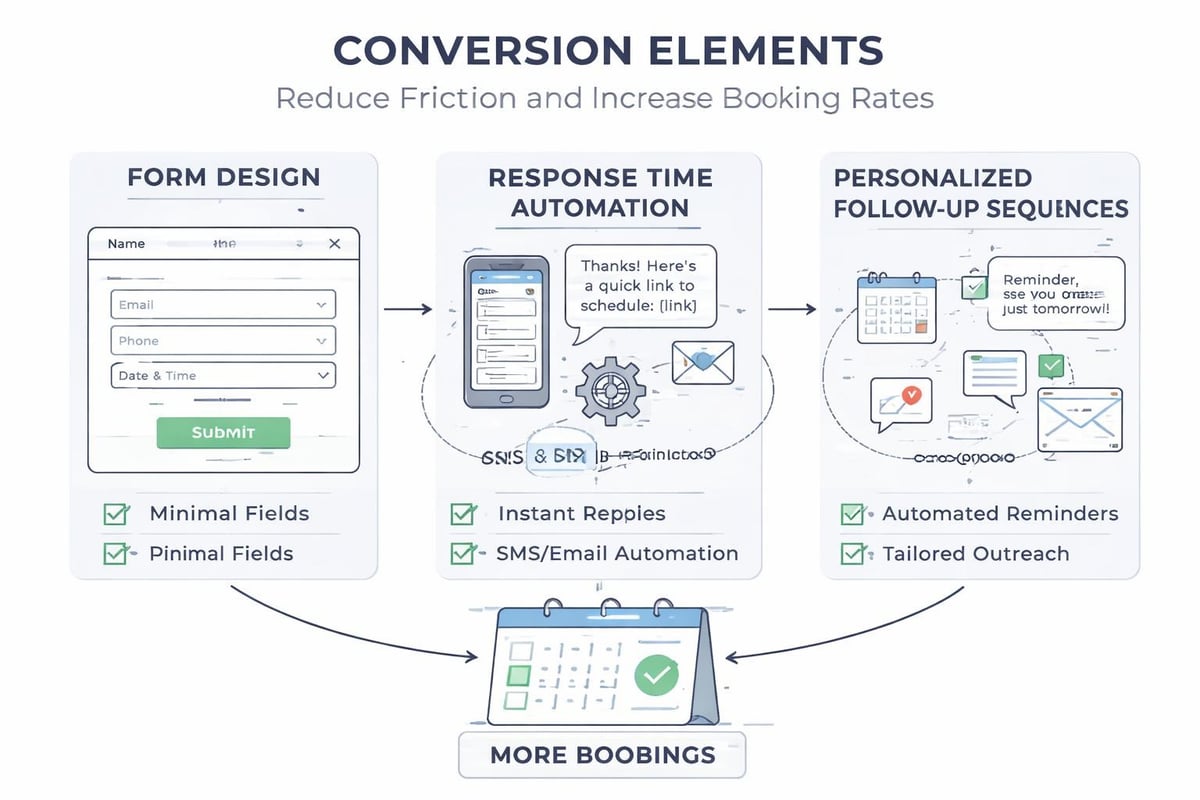
Every field in your lead capture form, every step in your booking process, and every delay in response time decreases conversion rates. Ruthlessly eliminate anything that doesn't directly contribute to qualifying prospects or moving them forward.
The ideal decision-stage experience:
- Clear, compelling offer that solves a specific problem
- Minimal form fields (only essential qualifying information)
- Immediate confirmation and next steps
- Fast response time (ideally under 5 minutes)
- Personalized follow-up addressing specific needs
The shift from cold outreach to warm engagement demonstrates why nurturing matters. Prospects nurtured through your funnel convert at dramatically higher rates than cold contacts because they've already been convinced through your content.
Leveraging Technology for Funnel Automation
The funnel in digital marketing has been revolutionized by automation technology that maintains personal touches while scaling infinitely. Manual processes simply cannot compete with AI-powered systems that respond instantly, personalize experiences, and optimize continuously.
Marketing automation platforms now handle lead scoring, email sequences, retargeting campaigns, and appointment scheduling without human intervention. This doesn't replace strategic thinking-it amplifies it by executing your strategy flawlessly every single time.
Implementing AI-Driven Funnel Components
Modern AI in digital advertising enables predictive lead scoring that identifies which prospects are most likely to convert. Instead of treating all leads equally, your system can prioritize high-intent prospects while continuing to nurture others automatically.
Essential automation components include:
- Lead capture forms with intelligent routing
- Behavioral email triggers based on prospect actions
- Dynamic content adapting to prospect interests
- Automated appointment booking with calendar integration
- Retargeting campaigns following prospect behavior
The comprehensive guide to building great digital sales funnels emphasizes mapping customer journeys before implementing automation. Technology should enhance your strategy, not replace strategic thinking about what prospects need at each stage.
Integration across platforms ensures no prospect falls through cracks. When your advertising platform connects to your CRM, which triggers email sequences and schedules follow-ups, the entire funnel in digital marketing operates as one seamless system.
Measuring and Optimizing Funnel Performance
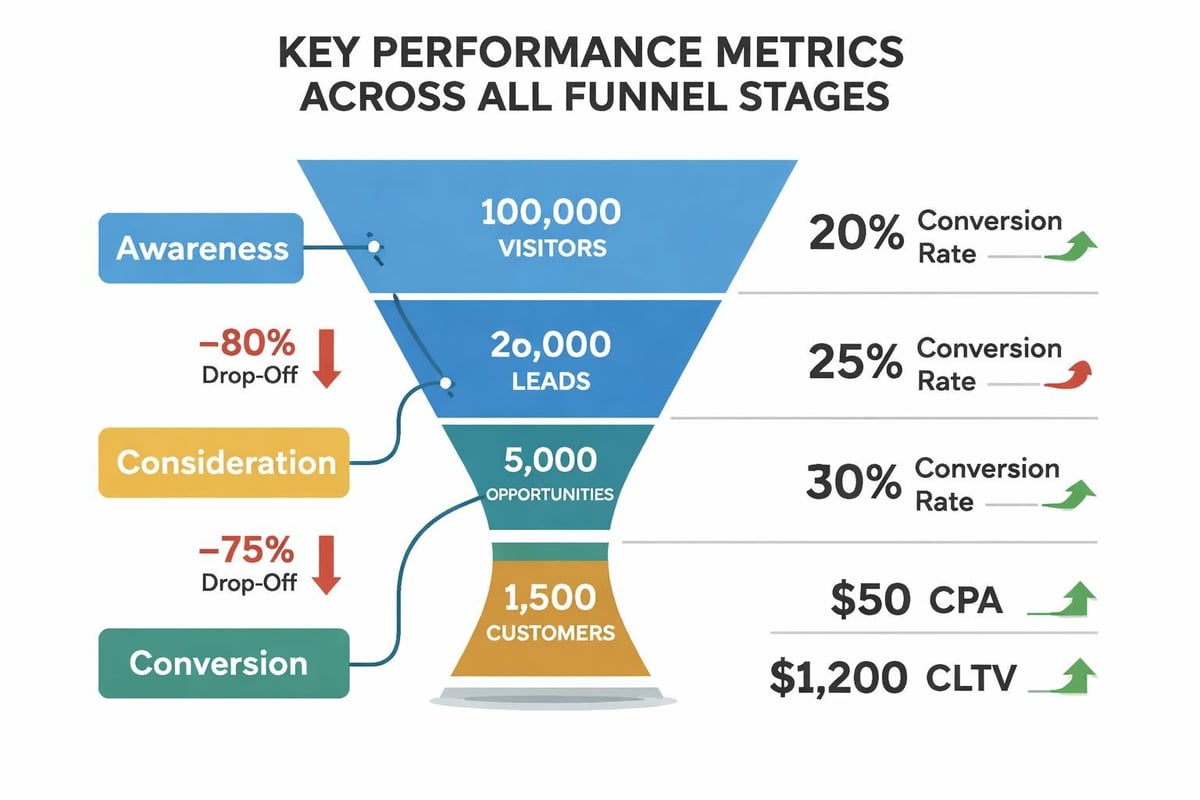
You cannot improve what you don't measure. The funnel in digital marketing provides quantifiable metrics at every stage, enabling data-driven optimization that continuously increases conversion rates and reduces acquisition costs.
Most businesses track top-level metrics like total leads or conversion rate, missing the detailed insights that reveal exactly where improvements drive maximum impact. Stage-by-stage analysis identifies specific bottlenecks and opportunities.
Key Performance Indicators Worth Tracking
| Metric | What It Reveals | Target Benchmark |
|---|---|---|
| Traffic-to-Lead Rate | Awareness content effectiveness | 2-5% |
| Lead-to-MQL Rate | Interest nurturing performance | 20-30% |
| MQL-to-SQL Rate | Qualification accuracy | 30-50% |
| SQL-to-Customer Rate | Sales conversion effectiveness | 20-30% |
| Customer Acquisition Cost | Overall funnel efficiency | Varies by industry |
| Customer Lifetime Value | Long-term profitability | 3x CAC minimum |
The tried and true method for filling your calendar focuses on conversion rate optimization at each stage rather than just increasing top-of-funnel traffic. Doubling your traffic with the same conversion rates doubles leads-but doubling conversion rates doubles leads without increasing ad spend.
Testing and Iteration Strategies
Continuous testing reveals what actually works versus what you think works. A/B testing headlines, offers, form lengths, and follow-up sequences produces data-driven insights that compound over time.
Priority testing areas include:
- Landing page headlines and value propositions
- Call-to-action button text and placement
- Email subject lines and send times
- Retargeting ad creative and messaging
- Form field requirements and ordering
The ultimate guide to digital marketing funnels from marketing experts emphasizes that optimization never ends. Market conditions change, competitor strategies evolve, and prospect expectations shift. Your funnel must adapt continuously.
Advanced Funnel Strategies for Complex B2B Sales
B2B sales with longer cycles and multiple decision-makers require sophisticated funnel approaches that account for committee-based buying and extended evaluation periods. The funnel in digital marketing for B2B differs significantly from B2C impulse purchases.
In complex B2B environments, a single contact rarely makes purchasing decisions alone. Your funnel must engage multiple stakeholders, providing role-specific content that addresses each person's unique concerns and priorities.
Multi-Touch Attribution and Long-Cycle Nurturing
Understanding which touchpoints contribute to conversions becomes exponentially more complex when sales cycles span weeks or months. Multi-touch attribution models reveal how awareness content, nurturing emails, retargeting ads, and sales calls work together to close deals.
Effective long-cycle strategies:
- Segment content by role (decision-maker, influencer, end-user)
- Implement lead scoring based on engagement depth
- Create sales enablement materials for committee presentations
- Maintain consistent nurturing without becoming annoying
- Use intent data to identify high-readiness prospects
The shift toward authority-based marketing reflects growing sophistication in B2B buying. Prospects research extensively before engaging sales teams, making thought leadership and credibility essential funnel components.
Exploring free B2B lead generation tools can supplement paid strategies, but the funnel in digital marketing requires investment in premium tools and platforms for serious results. Free tools work for testing; scaling demands sophisticated technology.
Integrating Email Marketing Into Your Funnel
Email remains the highest-ROI channel in the funnel in digital marketing, delivering $36 for every dollar spent according to recent research. However, generic email blasts don't work-strategic sequences aligned with funnel stages drive results.
Your email strategy should mirror prospect progression through awareness, interest, and decision stages. Early-stage emails educate and build credibility. Mid-stage emails demonstrate expertise and differentiate your solution. Late-stage emails create urgency and remove objections.
Segmentation and Personalization Tactics
One-size-fits-all email campaigns achieve mediocre results across all segments. Strategic segmentation based on industry, company size, behavior, and funnel stage enables relevant messaging that actually converts.
High-impact email sequences include:
- Welcome series for new subscribers establishing expectations
- Educational drip campaigns delivering consistent value
- Re-engagement campaigns for inactive prospects
- Event-triggered emails based on specific actions
- Personalized outreach for high-intent behaviors
Understanding why traditional emailing and calling doesn’t work anymore highlights the importance of value-first communication. Every email must provide something useful, not just ask for meetings or sales.
The most effective email funnels combine automation with personalization. Templates save time while dynamic fields, conditional content, and behavioral triggers create experiences that feel individually crafted.
Retargeting and Re-engagement Strategies
Most prospects don't convert on first exposure. The funnel in digital marketing must include systematic re-engagement that keeps your solution top-of-mind without annoying prospects who aren't ready yet.
Retargeting campaigns following website visitors across the internet remind them about your solution while they continue researching. Strategic retargeting segments audiences by which pages they visited, creating relevant follow-up messages.
Platform-Specific Retargeting Approaches
| Platform | Best For | Typical CPC | Conversion Lift |
|---|---|---|---|
| Google Display | Broad reach | $0.50-$2.00 | 30-50% |
| Facebook/Instagram | Visual engagement | $0.75-$3.00 | 40-60% |
| B2B professionals | $2.00-$6.00 | 50-70% | |
| YouTube | Video demonstrations | $0.10-$0.30 | 35-55% |
Frequency capping prevents retargeting fatigue while ensuring adequate exposure. Showing the same ad dozens of times daily annoys prospects; strategic frequency balances visibility with respect for their attention.
The best marketing platforms integrate retargeting with other funnel components, creating cohesive experiences across channels. Prospects might see your content ad, visit your website, receive retargeting ads, get nurturing emails, and finally book a consultation-all feeling like natural progression.
Creating Bottom-Funnel Urgency Without Manipulation
The final stage of your funnel in digital marketing requires creating compelling reasons to act now rather than later. However, false scarcity or manipulative tactics damage credibility and hurt long-term brand value.
Authentic urgency stems from genuine business realities: limited calendar availability, promotional periods ending, or seasonal relevance. These create natural deadlines without feeling manipulative.
Ethical Urgency Tactics
Legitimate urgency creators include:
- Limited consultation slots available this month
- Promotional pricing ending on specific dates
- Early-bird registration for events or programs
- Seasonal relevance (tax planning, budget cycles)
- Product inventory for physical offerings
Transparency builds trust even when creating urgency. Instead of vague claims like "limited time only," specify exact deadlines and reasons. "We're booking April consultations now, and only three slots remain" provides specific, verifiable information.
The approach to end-to-end marketing emphasizes consistency from initial awareness through conversion and retention. Urgency tactics should align with your overall brand voice and values, not contradict them.
Post-Conversion Funnel Extensions
The funnel in digital marketing doesn't end at purchase. Smart businesses extend funnels into retention, upselling, and referral generation, dramatically increasing customer lifetime value and reducing reliance on new customer acquisition.
Existing customers already trust your brand, making them far easier to sell to than cold prospects. Strategic post-purchase funnels maximize this advantage through onboarding sequences, value delivery, and expansion opportunities.
Building Loyalty and Advocacy Programs
Delighted customers become your best marketing channel through referrals and testimonials. Systematic programs that encourage and reward advocacy turn satisfied clients into lead generation engines.
Effective post-conversion strategies:
- Comprehensive onboarding ensuring successful implementation
- Regular check-ins demonstrating ongoing value
- Educational content helping clients maximize results
- Upsell opportunities aligned with growing needs
- Referral programs with mutual benefits
Exploring lead generation categories reveals how businesses combine acquisition with retention for sustainable growth. The most profitable companies balance new customer acquisition with maximizing existing customer value.
Understanding the complete customer journey from initial awareness through advocacy creates competitive advantages that compound over time. Every stage feeds the next, creating self-reinforcing growth.
The funnel in digital marketing provides the strategic framework for transforming strangers into customers systematically and profitably. By understanding each stage, optimizing continuously, and leveraging modern technology, businesses can build predictable revenue engines that scale efficiently. If you're ready to implement a sophisticated funnel that generates qualified leads and automates appointment bookings while you focus on closing deals, Adstra specializes in creating AI-powered systems that transform cold prospects into ready-to-buy customers with guaranteed results.