
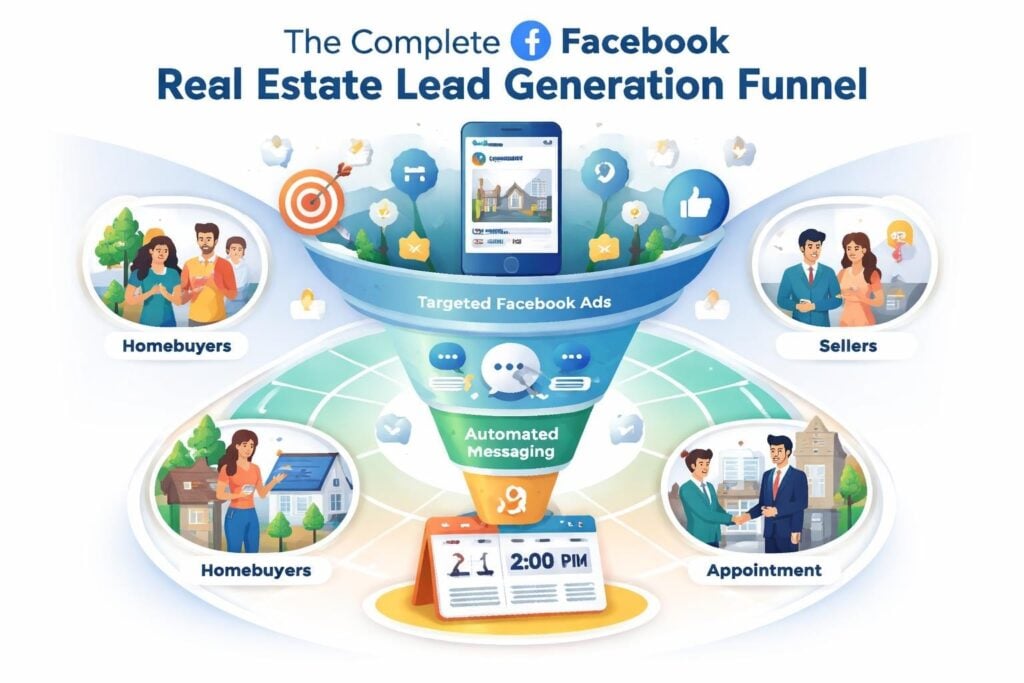
Real estate agents face an increasingly competitive landscape where traditional prospecting methods no longer deliver consistent results. Facebook has evolved from a simple social platform into a sophisticated lead generation powerhouse, offering real estate professionals unprecedented access to homebuyers and sellers at every stage of their journey. The challenge isn't finding potential clients on Facebook-it's converting those interactions into qualified appointments that actually close. With over 2.9 billion active users and advanced targeting capabilities, facebook real estate lead generation has become the cornerstone of successful real estate marketing strategies that deliver predictable growth.
Why Facebook Dominates Real Estate Lead Generation
Facebook's advertising platform provides real estate agents with targeting precision that traditional marketing channels simply cannot match. You can reach potential homebuyers based on life events like marriage, job changes, or relocations-signals that indicate imminent housing decisions.
The platform's algorithm learns from user behavior, continuously optimizing your campaigns to reach people most likely to engage with your listings. This machine learning capability means your advertising budget works harder over time, identifying patterns in who clicks, who fills out forms, and who actually books consultations.
Key advantages that make Facebook irreplaceable for real estate:
- Life event targeting captures people during major transitions
- Behavioral data identifies active home searchers
- Lookalike audiences find prospects similar to your best clients
- Retargeting capabilities keep your brand top-of-mind
- Cost-effective reach compared to traditional media
The Evolution of Real Estate Advertising on Social Media
The landscape has shifted dramatically from simple property photos to sophisticated, multi-touch campaigns that nurture relationships over weeks or months. Understanding why Facebook real estate ads may not be generating leads helps you avoid common pitfalls that drain budgets without results.
Modern facebook real estate lead generation requires a systematic approach that combines compelling creative, strategic targeting, and automated follow-up systems. Agents who treat Facebook as just another place to post listings miss the platform's true potential-building relationships at scale.
Building Your Facebook Lead Generation Infrastructure
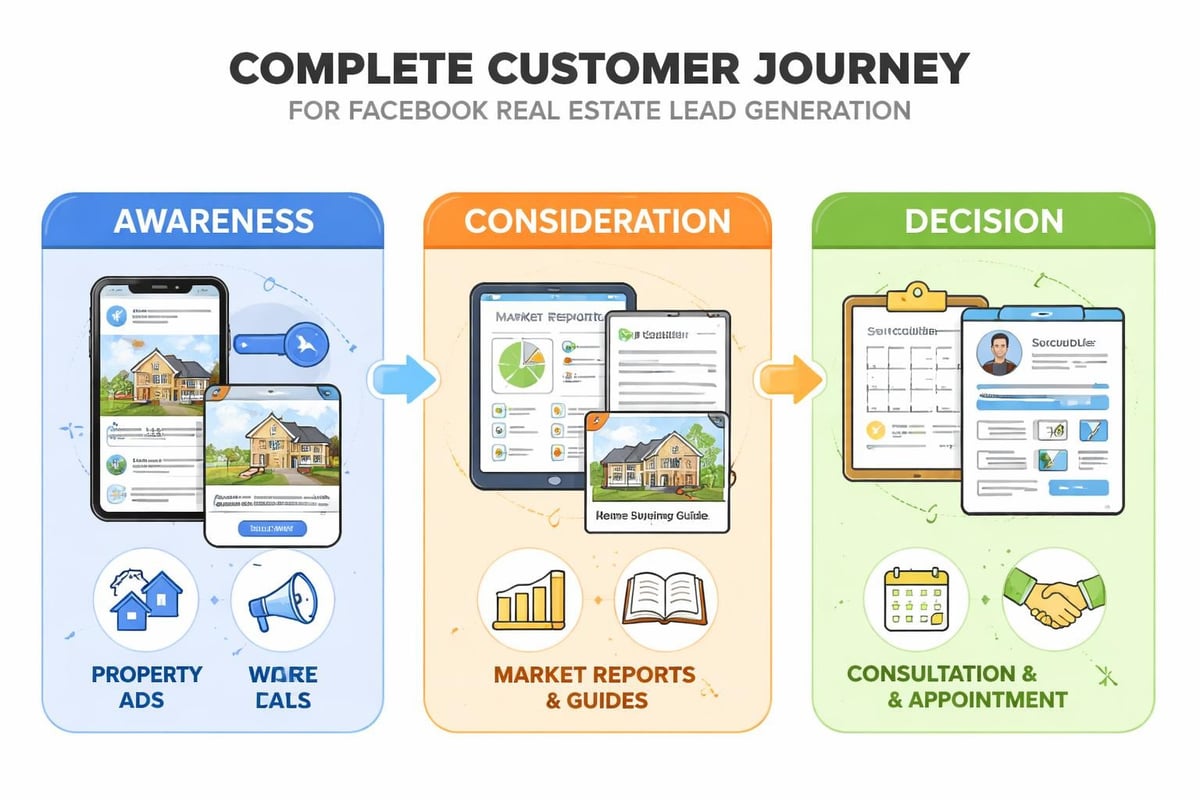
Success with facebook real estate lead generation starts with proper campaign infrastructure that captures leads and moves them systematically toward appointments. Too many agents focus exclusively on ad creative while neglecting the conversion architecture that actually generates revenue.
Your lead generation system needs three core components: compelling offers, frictionless capture mechanisms, and immediate follow-up automation. Each element plays a critical role in converting social media engagement into closed transactions.
Crafting Irresistible Lead Magnets
Generic "contact us for more information" calls-to-action no longer cut through the noise. Your offer must provide immediate, tangible value that justifies sharing contact information.
High-converting lead magnets for real estate:
- Neighborhood market reports with pricing trends and inventory analysis
- Home valuation tools that estimate property worth in minutes
- Buyer's guides for first-time purchasers navigating the process
- Investment property calculators showing potential ROI
- School district comparisons for families with children
The key is matching your offer to the prospect's stage in their buying or selling journey. Someone researching neighborhoods needs different information than someone ready to list their home next month. Creating qualified leads requires this level of strategic thinking about what prospects actually need.
Optimizing Lead Forms for Maximum Conversions
| Form Element | Best Practice | Conversion Impact |
|---|---|---|
| Number of Fields | 3-5 maximum | Reduces friction by 40% |
| Pre-filled Information | Use Facebook data | Increases completion by 35% |
| Mobile Optimization | Large tap targets | Captures 70% more leads |
| Privacy Messaging | Clear data usage | Builds trust, improves quality |
Facebook's native lead forms pre-populate information from user profiles, dramatically reducing the effort required to submit contact details. This seamless experience converts significantly better than directing traffic to external landing pages.
However, convenience comes with a tradeoff. Instant lead forms lower the barrier so much that lead quality can suffer. Balancing form simplicity with qualification questions-like "When are you planning to move?"-helps filter serious prospects from casual browsers.
Targeting Strategies That Find Ready-to-Buy Prospects
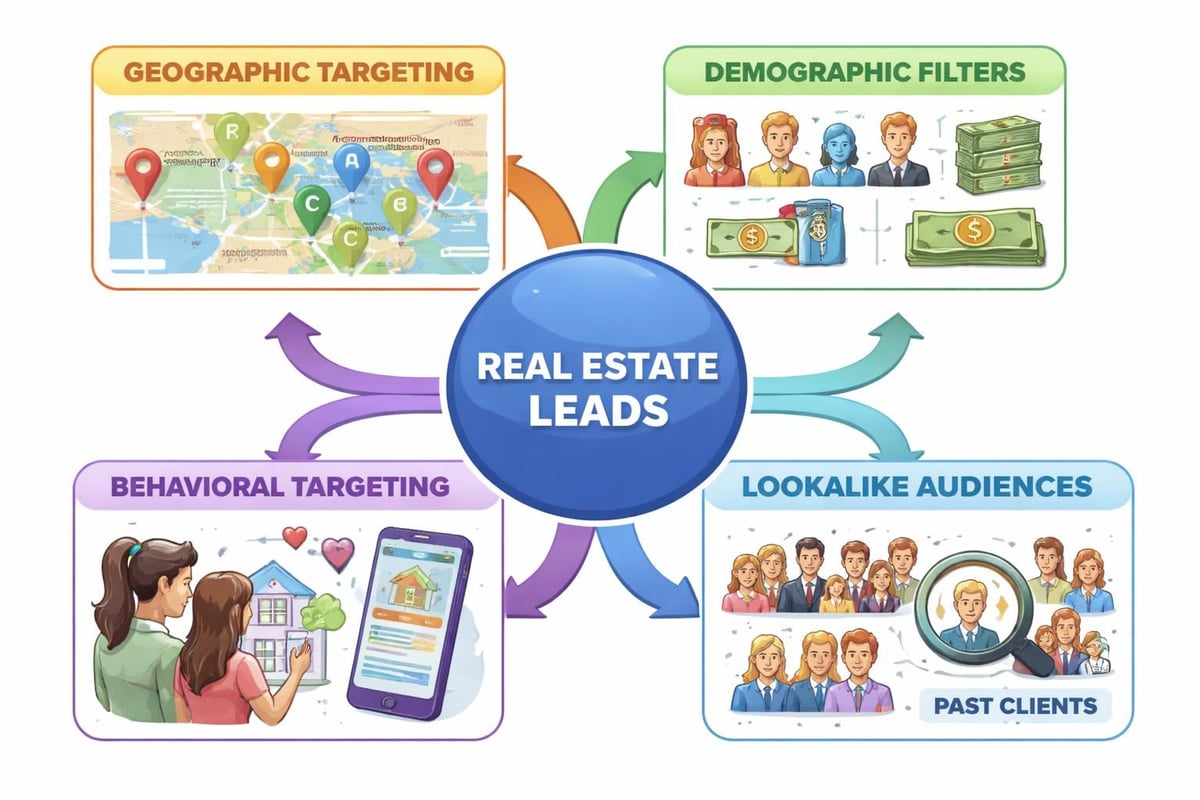
The difference between profitable and wasteful facebook real estate lead generation campaigns often comes down to audience targeting. Facebook provides dozens of targeting options, but not all deliver equal results for real estate professionals.
Start with location targeting based on the specific neighborhoods, ZIP codes, or radius around areas where you operate. Layer on demographic filters like age ranges, household income, and homeownership status to narrow your audience to viable prospects.
Leveraging Facebook's Advanced Targeting Capabilities
Beyond basic demographics, Facebook's interest and behavior targeting unlocks powerful segmentation. You can reach people who've engaged with real estate content, visited property websites, or shown interest in home improvement-all signals of potential buyers or sellers.
Lookalike audiences represent one of the most effective strategies for scaling facebook real estate lead generation. By uploading your client list or website visitors, Facebook identifies users with similar characteristics and behaviors, effectively cloning your best customers. Strategies to ignite lead generation on Facebook include building these sophisticated audience segments.
Behavioral targeting options for real estate:
- Recently moved or planning to move
- Engaged shoppers looking at luxury goods
- Likely to move based on life events
- Interested in home improvement content
- Frequent visitors to real estate websites
Geographic Farming Through Micro-Targeting
Dominating specific neighborhoods requires concentrated visibility within tight geographic boundaries. Facebook allows targeting down to one-mile radiuses, perfect for farming particular subdivisions or communities.
Combine location targeting with custom messaging about neighborhood-specific market conditions, recent sales, or upcoming open houses. This hyperlocal approach positions you as the neighborhood expert, the obvious choice when someone decides to buy or sell.
Campaign Structures That Drive Consistent Lead Flow
Random, sporadic advertising produces random, sporadic results. Sustainable facebook real estate lead generation requires systematic campaign structures that run continuously, testing and optimizing toward lower costs and higher quality leads.
Most successful agents run three concurrent campaign types: awareness campaigns building brand recognition, consideration campaigns offering valuable resources, and conversion campaigns driving immediate action. This full-funnel approach ensures you're nurturing prospects at every stage.
Awareness Campaigns: Building Your Brand
Awareness campaigns introduce your services to cold audiences who've never heard of you. The goal isn't immediate leads-it's establishing credibility and familiarity that makes future marketing more effective.
Use video content showcasing your personality, expertise, and client success stories. Share market insights, neighborhood tours, and educational content that positions you as a trusted resource. These campaigns typically optimize for video views or engagement rather than lead form submissions.
Budget 30-40% of your facebook real estate lead generation spending on awareness. While these campaigns don't generate direct leads, they dramatically improve conversion rates on your bottom-funnel campaigns by warming up audiences first.
Consideration Campaigns: Nurturing Interest
Consideration campaigns target people who've engaged with your awareness content or visited your website. These warmer audiences receive offers like market reports, home valuations, or buyer guides-valuable resources that require contact information.
This middle-funnel stage generates the bulk of leads for most real estate campaigns. The prospects aren't ready to book appointments yet, but they're actively researching and gathering information. Your goal is capturing their contact details so you can nurture them toward a consultation.
Proven consideration campaign offers:
- Downloadable guides on buying or selling locally
- Free home value estimates
- Neighborhood market trend reports
- Mortgage calculator tools
- School district comparison tools
Conversion Campaigns: Driving Appointments
Conversion campaigns target your warmest audiences-people who've downloaded resources, visited your website multiple times, or engaged extensively with your content. These prospects receive direct calls-to-action to book consultations, schedule showings, or request listing presentations.
Budget 25-30% of spending here, knowing these campaigns produce your highest-intent leads. The cost per lead will be higher, but the conversion rate from lead to client should be substantially better. Learning from how real estate agents can use Facebook ads to generate seller leads helps optimize these high-value campaigns.
Creative Strategies That Stop the Scroll
Even perfect targeting fails without creative that captures attention in crowded news feeds. Your ads compete with friends, family, and entertainment content-you have milliseconds to earn engagement.
Video consistently outperforms static images for facebook real estate lead generation, particularly authentic, personal content rather than overly polished commercials. Property tours, market updates delivered to camera, and client testimonials all generate strong engagement.
Crafting Compelling Ad Copy
Your ad copy must speak directly to prospect pain points and desires. Generic statements about "full-service real estate" blend into the background. Specific benefits and clear value propositions earn clicks.
Start with a pattern interrupt-a surprising statistic, provocative question, or bold statement that stops scrolling. Follow with clear benefits focused on what the prospect gains, not what you offer. End with a specific call-to-action that tells people exactly what to do next.
| Copy Element | Weak Example | Strong Example |
|---|---|---|
| Hook | "Looking to buy a home?" | "Home prices in [Neighborhood] jumped 12% last month" |
| Value Prop | "I'm a great agent" | "My buyers save $18K on average through negotiation" |
| CTA | "Contact me today" | "Download our buyer's guide and save thousands" |
Visual Best Practices for Real Estate Ads
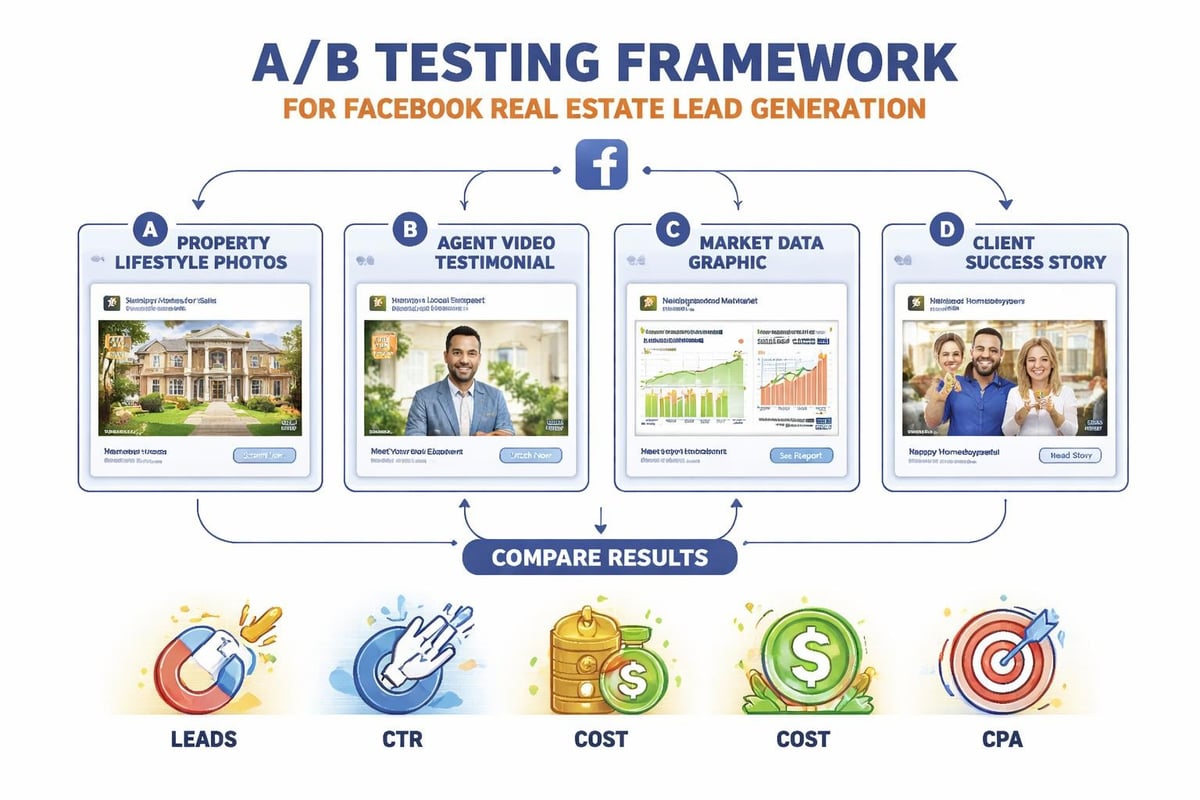
Images and videos should showcase properties while evoking emotional responses. Lifestyle shots showing families in homes outperform empty room photos. Include people in your creative whenever possible-humans instinctively connect with other humans.
Test multiple creative variations within each campaign. Facebook's algorithm will automatically show the best-performing ads more frequently, but you need to provide variety for the system to optimize. Understanding lead generation with AI can help automate creative testing at scale.
Automation Systems That Convert Leads to Appointments
Generating leads is only half the battle-converting them into booked appointments determines actual ROI. Most real estate agents lose 60-70% of potential clients due to slow or inconsistent follow-up after the initial lead capture.
Modern facebook real estate lead generation requires automation that responds instantly when someone submits their information. Immediate engagement dramatically improves conversion rates compared to delayed outreach, even delays of just minutes.
Instant Response Mechanisms
Facebook lead ads integrate with CRM systems and automation platforms, triggering immediate email and SMS sequences the moment someone submits a form. Your first message should arrive within 60 seconds, while the prospect is still engaged and thinking about their real estate goals.
This initial touchpoint confirms receipt of their request and sets expectations for next steps. Include the value they requested (market report, home valuation, etc.) immediately rather than making them wait for manual delivery.
Components of effective instant response:
- Automated email delivering promised resource
- SMS text thanking them and previewing next steps
- Calendar link for easy appointment scheduling
- Personal video message introducing yourself
- Clear timeline for when you'll personally follow up
Nurture Sequences That Build Trust
Not every lead is ready to book an appointment immediately. Most prospects need multiple touchpoints over days or weeks before they're comfortable committing to a conversation. Your automated nurture sequence bridges this gap.
Create a sequence of valuable emails sharing market insights, success stories, and educational content. Mix automated messages with personal outreach, using your CRM to trigger manual tasks when prospects show high engagement-like visiting your website multiple times or clicking specific links.
The best agents combine automated efficiency with personal touches. Technology handles consistent follow-up and information delivery, while you focus on high-value activities like consultations and showings. This is the core philosophy behind building systems that force leads to book sales calls.
Measuring and Optimizing Campaign Performance
Sustainable facebook real estate lead generation requires rigorous tracking and continuous optimization. Too many agents judge campaigns solely on cost per lead, missing critical metrics that actually predict business growth.
Track the entire funnel from ad spend through closed transactions. Your cost per lead matters far less than your cost per client and return on ad spend. A campaign generating leads at $50 each that close at 10% outperforms a campaign generating $20 leads that close at 2%.
Key Metrics for Real Estate Facebook Campaigns
| Metric | What It Measures | Target Benchmark |
|---|---|---|
| Cost Per Lead | Acquisition efficiency | $15-$40 for buyers, $30-$80 for sellers |
| Lead to Appointment Rate | Follow-up effectiveness | 15-25% |
| Appointment to Client Rate | Sales conversion | 20-35% |
| Cost Per Client | True acquisition cost | $500-$2,000 |
| Return on Ad Spend | Revenue multiple | 5:1 minimum |
Testing Methodology for Continuous Improvement
Run structured A/B tests changing only one variable at a time-creative, copy, audience, or offer. This isolated testing reveals what actually drives performance improvements versus random variation.
Dedicate 20% of your budget to testing new approaches while maintaining 80% on proven campaigns. This balance provides room for innovation without risking your core lead generation engine. Many successful strategies come from practical ways to use AI for outsized marketing results.
Scaling Profitable Campaigns Without Killing Performance
Once you've identified winning campaigns, the temptation is to dramatically increase budgets overnight. However, facebook real estate lead generation campaigns often see degraded performance when scaled too aggressively.
Facebook's algorithm needs time to adjust to new budget levels and find additional qualified prospects. Increase spending by 20-30% every 3-4 days rather than doubling budgets immediately. This gradual scaling maintains lead quality and cost efficiency.
Expanding to New Markets and Audiences
After exhausting your primary geographic markets, expand systematically to adjacent neighborhoods or nearby cities. Clone your best-performing campaigns and adapt the creative and copy for new locations rather than starting from scratch.
Build new lookalike audiences based on your highest-value clients-those who've closed the largest transactions or referred others. These "best customer" lookalikes often outperform general client lookalikes by finding prospects with similar high-value characteristics.
Scaling strategies that maintain performance:
- Increase budgets gradually (20-30% every 3-4 days)
- Expand to lookalike audiences at higher percentages (1% to 2% to 3%)
- Test new geographic markets with proven creative
- Add new offer types to diversify lead sources
- Implement retargeting to re-engage non-converters
Managing Multiple Campaigns at Scale
As your facebook real estate lead generation expands, managing dozens of concurrent campaigns becomes challenging without proper systems. Implement naming conventions that instantly identify campaign objectives, audiences, and testing variables.
Use campaign budget optimization (CBO) to let Facebook automatically allocate spending across ad sets within campaigns based on performance. This machine learning approach often outperforms manual budget management, finding the best opportunities automatically.
Budget Allocation and ROI Expectations
Real estate agents frequently ask how much they should spend on facebook real estate lead generation. The answer depends on your market, commission averages, and sales conversion rates, but general guidelines provide starting points.
Allocate at minimum $1,500-$3,000 monthly to generate meaningful results. Smaller budgets spread across multiple campaigns dilute effectiveness, preventing the algorithm from gathering sufficient data for optimization. It's better to run fewer campaigns with adequate budgets than many underfunded campaigns.
Calculating Your Maximum Allowable Cost Per Lead
Work backward from your average commission to determine how much you can profitably spend acquiring clients. If your average commission is $10,000 and you're willing to invest 15% in marketing, that's $1,500 per client.
If your lead-to-client conversion rate is 5%, you can spend $75 per lead profitably ($1,500 ÷ 20 leads). Understanding these economics prevents premature campaign shutdowns and unrealistic performance expectations.
Budget calculation framework:
- Average commission: $10,000
- Marketing investment: 15% = $1,500 per client
- Lead to client conversion: 5% (1 in 20)
- Maximum cost per lead: $75
- Monthly budget for 100 leads: $7,500
Timeline for Seeing Results
New facebook real estate lead generation campaigns typically require 30-45 days to stabilize and produce consistent results. The first two weeks involve algorithm learning, testing, and optimization-expect irregular performance during this period.
Month two usually shows improved metrics as Facebook's machine learning identifies optimal audience segments and delivery times. By month three, you should have clear data on true campaign performance and ROI. Strategies from top Facebook real estate lead generation tactics emphasize this patience during the optimization phase.
Facebook has fundamentally transformed how real estate professionals generate and convert leads, offering targeting precision and automation capabilities that make predictable growth possible at scale. The agents winning in 2026 treat facebook real estate lead generation as a systematic business process rather than random advertising, combining strategic campaigns with automated follow-up that converts social engagement into booked appointments. If you're ready to build a lead generation system that delivers qualified prospects and filled calendars month after month, Adstra specializes in leveraging advanced AI systems to automate this entire process-from campaign optimization through appointment booking-with a guaranteed growth partnership model that aligns our success with yours.